 Shib
ShibShib ShibaSwap supports token swaps and liquidity management through v1 LP tokens and v2 NFT positions.
Shib ShibaSwap lets a connected wallet exchange supported tokens and manage liquidity through v1 LP tokens or v2 NFT positions. A swap changes token balances, while a liquidity deposit creates a position in a trading pool. In v1, fungible liquidity provider (LP) tokens represent a share of a specific pool. In v2, a non-fungible token (NFT) records a position with a chosen price range. The wallet owner selects inputs and approves contract spending when required; pool contracts apply the transaction parameters. Network selection also determines the ordinary gas asset: ETH on Ethereum or BONE on Shibarium. Reading the quote, position type and transaction record together makes the resulting holding clear.
Updated -
Pool balances connect trades with liquidity ownership
Both ShibaSwap versions connect swaps with liquidity provision through token pools, where active liquidity supports trading between the pool’s assets. A swap transfers an input asset into the pool route and returns its output asset. Liquidity providers supply assets the pools use, then hold a representation of their position. Each pool has a token pair, identified by the token contracts on its network.
The wallet owner controls the request, including amounts and spending permission. ShibaSwap’s router handles the chosen trade path, while pool contracts calculate exchanges and update their accounting. A connected-wallet label identifies the account an interface is using. Allowances and pool positions have their own contract records.
Position records separate v1 pool shares from v2 price ranges
Fungible shares in v1
A v1 deposit supplies both pool assets at equal value and creates fungible LP tokens representing the provider’s share. The pool uses the constant-product relationship,
x * y = k
, where x and y represent token reserves. Deposits cover the full price range. Removing liquidity redeems the LP share for underlying pool assets. Because swaps change reserves, the token composition and value of the withdrawal can differ from the deposit. Equal token counts are unnecessary; equal value depends on the pool’s asset prices.
NFT positions in v2
ShibaSwap v2 represents individual liquidity positions as NFTs. Each position records its pool and price range. Its owner can increase or decrease liquidity and collect accrued fees for that position.
Range selection and swap fees
Concentrated liquidity allocates assets within the selected interval. The position can earn swap fees while the market price remains inside that range. Moving outside it stops new fee earning from swaps until the price returns. An out-of-range label describes eligibility to earn new swap fees; it does not calculate the position’s overall profit or loss.
Position value and impermanent loss
The NFT identifies a particular position, including its range and fee tier. Its displayed liquidity value reflects exposure to the pool’s assets. Choosing a range changes where liquidity participates; it does not fix a future withdrawal value. Token price changes can produce impermanent loss, meaning the pool position can underperform holding the same assets directly.
What changes when you swap tokens or supply liquidity?
A swap changes wallet token balances, while supplying liquidity creates a position exposed to the pool’s assets. An exact-input swap fixes the input token amount; an exact-output swap fixes the output token amount. A liquidity deposit allocates assets to a pool position whose value changes with trading and token prices. The resulting holding differs even when the same tokens appear in the interface.
| Action | Execution, withdrawal and fee conditions |
|---|---|
| Token swap | An exact-input swap reverts below its minimum output; an exact-output swap reverts above its maximum input. |
| v1 liquidity deposit | Full-range pool exposure; withdrawal depends on the LP share and pool reserves. |
| v2 liquidity deposit | Swap-fee earning requires the market price to remain inside the chosen range. |
| Swap output, v1 LP tokens and v2 NFTs represent different holdings. | |
A swap suits obtaining the output asset for a subsequent use. Liquidity provision suits making assets available for pool trading while retaining a redeemable position. A v2 position confines its active liquidity to the selected interval, with fee earning conditional on that interval. Full-range v1 liquidity avoids choosing a custom interval.
What does a ShibaSwap token approval authorize?
A ShibaSwap token approval grants a specified contract permission to spend an ERC-20 token up to the approved allowance. The
approve
function names the spender and allowance, while
allowance
reports the remaining authorized amount. Approval does not itself swap tokens or create a liquidity position. The operation requiring that permission follows its own transaction parameters. Existing sufficient allowance can satisfy the requirement without another approval.
Permission belongs to the combination of token owner, token contract and spender. Approving a router does not automatically authorize every staking or bridge contract. The wallet owner chooses whether to grant the requested amount and checks the spender before signing. The ERC-20 standard lets a later approval replace the allowance for that spender. Wallet interfaces may handle allowance changes differently, so an approval request should identify the exact contract and amount.
Quotes separate swap fees from network costs
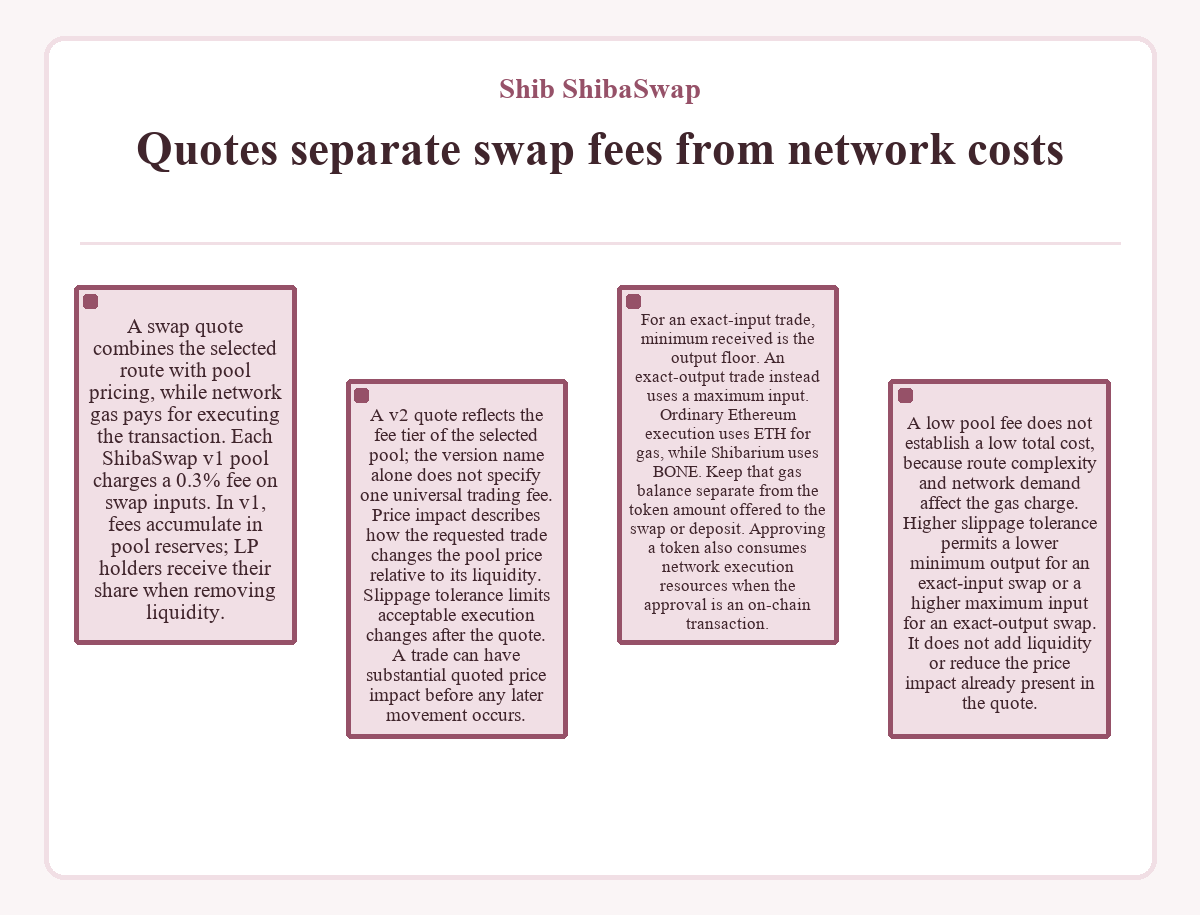
A swap quote combines the selected route with pool pricing, while network gas pays for executing the transaction. Each ShibaSwap v1 pool charges a 0.3% fee on swap inputs. In v1, fees accumulate in pool reserves; LP holders receive their share when removing liquidity. A v2 quote reflects the fee tier of the selected pool; the version name alone does not specify one universal trading fee.
Price impact describes how the requested trade changes the pool price relative to its liquidity. Slippage tolerance limits acceptable execution changes after the quote. A trade can have substantial quoted price impact before any later movement occurs. For an exact-input trade, minimum received is the output floor. An exact-output trade instead uses a maximum input.
Ordinary Ethereum execution uses ETH for gas, while Shibarium uses BONE. Keep that gas balance separate from the token amount offered to the swap or deposit. Approving a token also consumes network execution resources when the approval is an on-chain transaction. A low pool fee does not establish a low total cost, because route complexity and network demand affect the gas charge.
Higher slippage tolerance permits a lower minimum output for an exact-input swap or a higher maximum input for an exact-output swap. It does not add liquidity or reduce the price impact already present in the quote.
Contract records show transaction results
On Ethereum, a transaction receipt reports success or failure of the top-level call, so the operation behind that receipt matters. Approval success concerns the allowance change; liquidity-transaction success concerns the pool position. For a swap, token transfer records identify the assets and amounts moved. Token decimals translate raw contract units into the amounts a wallet displays.
Position monitoring follows the representation the deposit created. With v1, the LP-token balance records a share of its particular pool. With v2, the NFT identifies the individual position and its configured range. A pool asset balance left in the wallet is different from the assets represented inside a liquidity position. Likewise, an estimated position value cannot show whether a planned withdrawal has executed.
The wallet owner controls later approvals and management requests; contracts determine whether submitted parameters meet their execution rules. A successful swap already changed the holdings. Exchanging back is another trade with another quote. Changing an interface display cannot reverse those transfers. A liquidity withdrawal returns assets under the position’s pool rules.
Match pool exposure to the intended use
A token exchange fits a task requiring the output asset, such as a later transfer on the selected network. Liquidity provision keeps exposure to pool assets while earning fees from eligible swaps. The two choices change available wallet balances differently. Distinguish tokens intended for a payment, a governance lock or a direct SHIB burn from tokens allocated to pool liquidity.
Concentrated liquidity adds a price-range decision to the choice of pair and pool. Its custom interval can suit liquidity offered at selected prices, provided the market stays inside that interval for swap-fee earning. A v1 position supplies full-range liquidity and uses fungible LP shares. Neither position type promises that fee income will offset changes in the assets’ relative prices.
Holding the assets directly keeps them outside the pool’s liquidity accounting. It requires no LP share or NFT position to manage. Pool positions earn trading fees when their liquidity participates in swaps. Direct holdings retain the original token balances until another transaction changes them.
Shib ShibaSwap FAQs
Can ShibaSwap v1 trade native ETH?
ShibaSwap v1 automatically wraps native ETH into WETH for trading. Its pools use ERC-20 tokens; WETH supplies that token form for Ether. The amount entering a swap remains separate from ETH reserved for Ethereum gas. Receiving WETH gives the wallet a wrapped token balance; it does not itself create a native ETH balance.
How does multihop routing affect a ShibaSwap swap?
Multihop routing lets a ShibaSwap trade pass through intermediate token pools when the selected route uses them. Disabling multihop restricts routing to direct pairs, which can reduce available routes or change the quote. The quoted output reflects the selected path, including its liquidity and fees. A direct pair may quote differently from a route using intermediate pools; route availability and pricing change with the pools.
Is a ShibaSwap swap also an Ethereum-to-Shibarium bridge transfer?
A token swap exchanges assets through pools, while a bridge transfer moves a supported token representation between networks. A successful swap receipt alone does not establish a completed bridge transfer. Cross-network movement requires the bridge’s token mapping and transfer process. Selecting a same-named token on another network does not move the wallet’s existing holding there.
Does a ShibaSwap v1 LP balance qualify for Woof rewards?
LP tokens from eligible ShibaSwap v1 farming pairs can be staked through Woof for additional BONE rewards on Ethereum only. Holding LP tokens alone does not establish a Woof staking position or a claimable reward balance. The staking position and available rewards determine what the wallet can claim. Bury 2.0 uses a separate governance-lock mechanism; its beta grants voting power without staking rewards.
What token details matter when importing a missing swap asset?
A missing swap asset needs identification by its complete token contract address on the selected network. Different contracts can share a token name or symbol. Where token import is available, the token-selection search accepts the asset’s contract address. Token decimals determine the displayed amount. Importing a token into the interface does not establish sufficient liquidity for a trade.
Are ShibaSwap v2 contracts published in a public source repository?
ShibaSwap v2 uses modified Uniswap v3 contracts without a publicly available source repository. The architectural relationship explains its concentrated-liquidity model. It does not establish that every Uniswap v3 implementation detail applies unchanged to ShibaSwap v2.
Will a failed swap undo an earlier successful token approval?
A separately confirmed approval remains in effect when a later swap transaction reverts. The revert rolls back the failed call’s contract-state changes, while the earlier allowance belongs to an already completed operation. The remaining allowance determines the contract’s continuing spending permission. A failed swap message alone does not show that the wallet has removed that permission.
Can an Ethereum ShibaSwap trade reveal the wallet address and traded amounts?
ERC-20 Transfer events expose sender and recipient addresses together with raw token amounts. In a ShibaSwap trade, those records can connect the wallet with the pools it used. Token decimals convert the raw values into human-readable quantities. Transaction records describe on-chain activity, so a locally chosen wallet display name does not conceal the underlying address.