 Shib
Shib supports payments and DeFi with gas requirements that vary by network.
Shib is Shiba Inu’s ERC-20 token on Ethereum, used for transfers, accepted payments and decentralized finance applications. ERC-20 defines how wallets and applications handle fungible tokens. Its ticker is SHIB. ShibaSwap provides decentralized trading, while Shibarium hosts applications using supported token representations. Ordinary Ethereum transactions require ETH for gas; Shibarium uses BONE. Fees follow network demand and transaction complexity, with separate conditions for bridge access, trading permissions and merchant acceptance.
Updated -
Network choice changes the gas currency
The same SHIB asset has different ordinary gas requirements across its networks. Ethereum charges execution in ETH; Shibarium uses BONE.
Gas measures the computational work a transaction consumes. On Ethereum, the execution fee equals gas used multiplied by the effective gas price. Changing the transferred SHIB amount does not create a proportional gas charge. A swap or liquidity adjustment can perform different contract operations from a direct transfer, changing its execution requirements. Network demand affects the price of that work, while the gas token’s market price affects the fee’s cash equivalent. Pool charges remain separate from network gas. Moving assets between networks can introduce additional bridge transactions, even when subsequent Shibarium transactions cost less.
Bridging changes the token representation
The Ethereum-Shibarium bridge connects supported token contracts through mappings, so a deposit creates a corresponding representation on the destination network. A standard mapped deposit mints pegged tokens on Shibarium at a 1:1 ratio to tokens locked on Ethereum. The ordinary return mechanism burns the destination representation and unlocks the corresponding Ethereum tokens. That bridge burn retires a representation while releasing its backing; it does not independently remove the same quantity from combined circulating supply.
State Sync carries information from Ethereum into Shibarium. Validators on the Heimdall layer listen for a
StateSynced
event and pass its data to a mapped receiver contract. Transfers back depend on checkpoint information and the applicable exit mechanism. The bridge architecture includes proof-of-stake (PoS) and Plasma mechanisms, with token compatibility and withdrawal conditions specific to each route.
Standard bridge availability remains specific to the asset and route. Following bridge losses, holders can burn eligible restoration tokens on Shibarium to initiate cross-chain minting of SOU non-fungible tokens (NFTs) on Ethereum. Those claims represent affected balances within a recovery process, separate from an ordinary bridged SHIB balance.
Can SHIB pay for a purchase?
SHIB can pay for a purchase when the recipient or payment integration accepts that token on the network carrying the payment. A direct token transfer moves the balance to the recipient’s address. The recipient must accept that particular token representation, and the sender needs the network’s ordinary gas currency unless a supported integration handles gas. An application’s name or a merchant’s general acceptance of cryptocurrency does not establish support for every SHIB network.
Shiba Inu’s Crypto Payment API gives applications a separate payment-session system with status updates. Its merchant onboarding requires manual approval. Creating a session leaves the payment pending; an accepted status represents completed blockchain payment confirmation. A rejected status reports payment rejection or processing failure; an abandoned status reports the user left without completing payment. The application must retain the session’s amount and currency and reconcile its status with the purchase. This integration supports a payment workflow, while the currencies and networks offered for a particular session determine what the customer can actually pay.
ShibaSwap pools connect trading with liquidity provision
Trading through a pool
ShibaSwap is a decentralized exchange on Ethereum and Shibarium, where supported pools exchange tokens using liquidity supplied to their contracts. A swap changes the assets held after execution. Available liquidity and the selected amount affect the exchange price; pool fees and network gas add separate costs. Slippage protection sets the permitted execution boundary. A quote describes an estimate, while a successfully executed swap establishes the actual transfer. An ERC-20 spending allowance authorizes a specific contract to move tokens within that allowance. The authorization does not itself establish a completed swap, and an interface may combine supported operations.
Supplying liquidity
Liquidity provision commits assets to a pool position, with a different exposure from simply holding SHIB. Changes in relative token prices can leave the position worth less than holding its original assets separately.
Fungible positions in v1
ShibaSwap v1 represents a liquidity provider’s share with fungible liquidity provider (LP) tokens. The pool’s trading activity generates fees for liquidity providers. On Ethereum, eligible v1 LP tokens can enter a separate farming arrangement for BONE rewards.
Price ranges in v2
ShibaSwap v2 represents concentrated liquidity positions as NFTs tied to selected price ranges. A position supplies active liquidity within its range and stops earning trading fees while out of range. The amount of active liquidity influences the position’s share of fees from trading within its range.
Token roles determine gas and governance access
SHIB belongs to a token family whose members perform different jobs across network operations and governance. BONE is Shibarium’s native gas token. It also supports validator staking, a network-security function separate from holding SHIB. The governance system includes distinct SHIB, BONE, LEASH and TREAT DAOs. The SHIB branch covers community initiatives; the BONE branch covers core protocol decisions. TREAT focuses on reward and utility decisions, while LEASH covers exclusive features and advanced governance. Each proposal’s voting strategy determines which balances or identities count. A balance in one token does not automatically supply another token’s gas or participation rights.
Voting rules determine the value of a token lock
A token lock changes governance power where the selected voting strategy recognizes vote-escrowed balances and their remaining lock duration. Other strategies can use ordinary token holdings, identity-based voting or quadratic voting. Locking is therefore one supported governance path, with its relevance determined by the particular proposal.
Governance locks on Shibarium
Bury 2.0 locks supported SHIB, TREAT, LEASH or BONE balances on Shibarium and represents their governance power with veTokens, meaning vote-escrowed tokens. Its beta configuration provides voting power without staking rewards. The interface supports locks up to four years. Withdrawing before a lock ends incurs a 30% penalty on the stake, leaving 70% of the staked tokens for the withdrawing holder. Those terms concern Bury 2.0 locks; they do not describe every product using the word staking.
Voting weight over time
The amount locked and its remaining duration determine vote-escrowed power, which declines as expiry approaches. For a fixed amount of one token, a longer lock initially grants more weight under this mechanism. The proposal still decides whether that balance participates and which strategy applies. Voting through Shib DAO is off-chain and gasless; creating a Bury 2.0 lock requires an on-chain transaction.
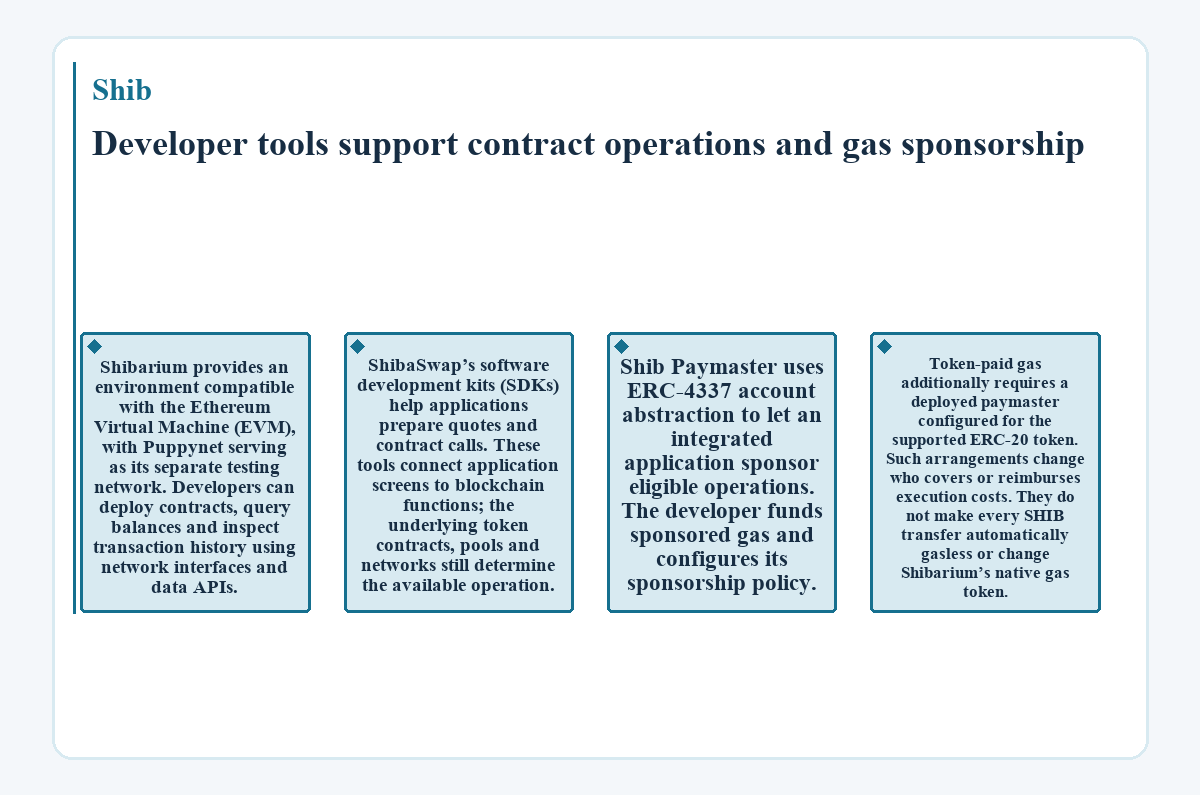
Developer tools support contract operations and gas sponsorship
Shibarium provides an environment compatible with the Ethereum Virtual Machine (EVM), with Puppynet serving as its separate testing network. Developers can deploy contracts, query balances and inspect transaction history using network interfaces and data APIs. ShibaSwap’s software development kits (SDKs) help applications prepare quotes and contract calls. These tools connect application screens to blockchain functions; the underlying token contracts, pools and networks still determine the available operation.
Shib Paymaster uses ERC-4337 account abstraction to let an integrated application sponsor eligible operations. The developer funds sponsored gas and configures its sponsorship policy. Token-paid gas additionally requires a deployed paymaster configured for the supported ERC-20 token. Such arrangements change who covers or reimburses execution costs. They do not make every SHIB transfer automatically gasless or change Shibarium’s native gas token.
Names and NFTs add separate application functions
Shib Name Service gives supported applications readable identifiers for wallet addresses and digital identity, with functionality governed by the relevant name integration. The earlier SNS contract is frozen, and the upgraded name system uses D3. These name tokens concern Web3 identity functionality, distinct from conventional Domain Name System (DNS) names. An application must support the name’s resolution before it can use the identifier in place of an address. Publicly resolving a name to a wallet can make its transactions easier to associate with the chosen identity.
Shiboshis are an NFT collection within the ecosystem. Shib: The Metaverse adds avatar customization, social exploration and plot building in its early-access virtual world. Plot building requires the relevant Metaverse Land NFT. The NFT represents that application’s ownership condition; an ordinary SHIB holding does not replace it.
Shib Portal groups downloadable applications and browser games. Its desktop launcher supports Windows; a browser title’s requirements remain separate from the launcher’s platform support.
Burn activity changes supply without setting a price
Permanent SHIB burns remove tokens from usable supply, with the recorded effect depending on the burn method. A contract-level SHIB burn destroys the caller’s tokens and reduces the Ethereum contract’s total supply counter. Transfers into inaccessible burn wallets can instead remove tokens from spendable circulation without changing that same contract counter. A burn percentage needs a stated supply basis and period before it can describe the scale of the reduction.
Lower supply does not determine a future trading price by itself. Demand and the liquidity available for trading also matter, so a burn count does not establish an achievable price target. Neither does a low price per SHIB establish a low total valuation.
Match the ecosystem component to the intended action
Holding SHIB supplies a token balance. ShibaSwap liquidity shares and Bury 2.0 voting balances come from different contracts, so the required component follows the intended action.
- For a direct SHIB transfer, the recipient must accept the token on the selected network, with ordinary gas funded in that network’s currency.
- For a ShibaSwap exchange, the selected pool must support the input token and the minimum output must fit the intended trade.
- For liquidity provision, the pool version determines the position type, while relative token prices affect its exposure.
- For Bury 2.0 governance power, the lock duration and early-withdrawal terms determine access to the underlying tokens.
- For cross-network use, the specific token representation needs a supported mapping and available route; restoration claims follow separate rules.
Shib FAQ
-
Can a failed Ethereum SHIB transfer still consume gas?
- An Ethereum transaction which executes and then fails can still consume gas. The network charges for computation already performed, even when the failure reverses its token movements. A wallet rejection or error before submission is different from an executed failure. The transaction receipt identifies execution status and gas used, so a failure message alone does not establish the charge.
-
How can a wallet show no SHIB when an explorer shows a balance?
- A wallet can omit a SHIB balance because it displays the wrong network or lacks the correct token entry. Both views must concern the same address, network and token contract. Adding the correct token entry changes the display; it does not move funds between chains. An explorer showing a different representation or address does not establish a balance in the wallet’s selected network.
-
What does a SHIB price target imply for market capitalization?
- A SHIB price target implies a total valuation only after you specify the circulating supply. Market capitalization equals price multiplied by circulating supply. It does not calculate the cash required to reach that price or the proceeds every holder could receive. Execution depends on available liquidity, and changing the supply assumption changes the implied valuation.
-
Does holding an SOU NFT guarantee repayment of an affected bridge balance?
- An SOU NFT does not guarantee repayment of bridge losses. It represents an eligible affected balance within a voluntary remediation system, with payouts dependent on funds the system receives and its distribution rules. The original principal records the tokens lost. The current principal tracks the remaining recovery balance as payouts or community contributions reduce it. Owning or transferring the NFT does not turn its remaining claim into an immediately withdrawable token balance.
-
Are Puppynet faucet tokens usable as mainnet funds?
- Puppynet faucet tokens are testing assets on a separate network and cannot serve as mainnet funds. They support development and trial transactions without supplying an actual Shibarium mainnet BONE balance. Identical token symbols do not merge balances across networks. Mainnet applications need assets on their configured mainnet, while a testnet transaction proves only what happened in that testing environment.